Any of you who are friends with me on FB may have already seen this but I just had to share. Especially because I was so rudely dismissed by a local repair guy - with an ironic moustache and skinny jeans - saying that it wasn't repairable or "not worth" repairing. I'll be fair. I always knew what would have to be done to repair it. But I was going to have some other work done on the electronics as well so I thought I would get them to do it all. After he presented me with his attitude I decided I'd do it myself.
This is a little photo essay about my 1978 Kramer DMZ400 bass - with an aluminium neck - and the nail biting repair that I performed myself. I took these photos with a GoPro on maximum "fish eye" cuz that's all I had around. Sorry about the sometimes wacky perspective.
So... a bad thing happened. The threads that allow the bolts that secure the neck to this bass.... failed. This is a big problem because the neck is made of aluminium.....
I know the pic is slightly blurry but, where once there were pristine alloy threads, there are now just.... useless holes.
Here's a pic that shows the cross section of the aluminium neck at the heel. Sort of a "T" beam with wood inserts.
The repair I'm about to attempt will require some assistance in the form of good ol' "Irish Courage".
Gulp.......
It's time to dispense with the guitar/luthier tools. What we need for this monster is a good ol' M5 HeliCoil thread repair kit. Seems I may have just learned a thing or two having spent all that time around bicycles for all those years....
First thing I needed to do is drill out the holes in the neck. Completely removing the old damaged threads. (Most people would use a lightweight, battery operated drill for this. Not me. I use a big ass hammer drill.)
Reaching the point of no turning back....
Hard to see in the photo but, there are now absolutely no threads and the holes have been enlarged. You can see evidence of the aluminium filings on the bench...
Placing the supplied tap into my trusty tap/die handle.....
.... I begin to cut new threads in the larger diameter holes.
Time for more courage...
Now, you can see that all three holes have new threads in them. But wait, those holes are now too big for the M5 bolts you need to use?!?
No worries! This is where the HeliCoil insert - those little things that look like springs - comes into play.
Install the insert onto the HeliCoil installation tool to "wind up" the insert....
...and slowly thread the insert into the newly threaded hole.
LOOK AT THAT! A brand new set of M5 threads.
Remove the installation "tang" from the inside of the hole with hammer and punch.
Three brand new M5 threaded holes. According to HeliCoil, a repair made to aluminium threads with their inserts is many times stronger than the original threads.
Using brand new machine screws and lock washers, I cross my fingers, say a Hail Mary and thread the first screw in....
....It worked!! It's an Easter miracle! Neck back in placed and torqued to spec. (By spec I mean, "until it feels about right to me."
Re-installed the serial number/cover plate.
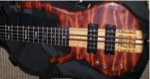
Re-strung and ready to play for another 36 years. I'm very happy about this. This bass sounds like nothing else I own. I was turned away at a local repair shop who wouldn't touch it.
Satisfaction at a job well done. And fooey on the hipster douchebag guitar tech who told me it was toast. I guess he only wants to fix '57 LP Goldtops.
Sometimes I think, maybe I'm lucky I'm left handed. If I could play any bass I wanted, my collection would REALLY be out of control.
Matt R. wrote:I've always wondered what those aluminum necks were like.
They are strong like a Ukranian Grandmother. They sustain like the Theramin of Zeus. And, the sound created by such a beast, can only be described as being struck by the hammer of the gods....
Sometimes I think, maybe I'm lucky I'm left handed. If I could play any bass I wanted, my collection would REALLY be out of control.
Matt R. wrote:I've always wondered what those aluminum necks were like.
They are strong like a Ukranian Grandmother. They sustain like the Theramin of Zeus. And, the sound created by such a beast, can only be described as being struck by the hammer of the gods....
Moses wrote:Awesome thread. Very cool to see that process. It seems to me that that repair job was extremely far from "impossible" or "not worth it."
That was - quite honestly - the point of the thread. I'm a pretty resourceful guy. But, sometimes, I just don't have the time or the inclination to do a repair on my own. It really chaps my ass when some shit sipper who I'm offering to give money to - in exchange for a service - acts like I'm wasting his time. The HeliCoil kit cost me $115 CAD w/tax and I would have gladly paid another competent person - which I thought I was engaging - to do this task. Cuz really, what am I gonna do with the other 12 M5 HeliCoil inserts I've got. That's like, every water bottle cage repair that an old school bike shop does in three or four years.
Sometimes I think, maybe I'm lucky I'm left handed. If I could play any bass I wanted, my collection would REALLY be out of control.
Moses wrote:Awesome thread. Very cool to see that process. It seems to me that that repair job was extremely far from "impossible" or "not worth it."
That was - quite honestly - the point of the thread. I'm a pretty resourceful guy. But, sometimes, I just don't have the time or the inclination to do a repair on my own. It really chaps my ass when some shit sipper who I'm offering to give money to - in exchange for a service - acts like I'm wasting his time. The HeliCoil kit cost me $115 CAD w/tax and I would have gladly paid another competent person - which I thought I was engaging - to do this task. Cuz really, what am I gonna do with the other 12 M5 HeliCoil inserts I've got. That's like, every water bottle cage repair that an old school bike shop does in three or four years.
Well, congrats anyway on saving a very cool old axe. You've done the world a service IMO.
Congrats! Nothing like a self repair (when it works ). The timing on this post was perfect, as I just literally learned about re-tapping kits and rethreading screws the other day at Home Depot in my attempt to repair one of the screws on a Steinberger I just picked up. (G string wouldn't tune to up to pitch due to damaged threads). Ultimately, I just hacksawed the tip of the screw off and still had enough length to get it working again.
I may pick up one of this kits anyway though. Looks very useful to have around.
Yeah. HeliCoils are amazeballs. I've used them for all kinds of things. A few years ago, when I was a team mechanic for a pro tour cycling team in Europe - who's name I won't mention for reasons of not wanting to defame the bike sponsor - we had every size imaginable on the truck. There was one particular failure related to a plate that held the rear breake onto their time trial bikes that was so common we just started replacing the threads with HeliCoils on that component as soon as the frames came out of the box. Got me out of more than a few jams for sure.
Sometimes I think, maybe I'm lucky I'm left handed. If I could play any bass I wanted, my collection would REALLY be out of control.
when I saw the first bolded sentence I thought to myself "oh no - don't do something stupid ... use a helicoil and be done with it" ... and then I read the remainder of your post with a smile
great job on saving a bass that tech thought was toast!
I installed many a helicoil in electrical cabinets where secure threads were important to keep water out and away from the 400v equipment inside. and like has been noted, they will far out last the alum threads your neck originally had.
for those who might attempt this kind of repair in the future, I'd recommend utilizing a drill press (instead of free-hand drilling) and setting the depth so that you don't also find yourself needing to install a new fretboard inlay. I'd also recommend utilizing a little bit of locktite on the threads after you've broken off the installation tab and center punched the thread to secure the helicoil position ... but DON'T test fit the screws until AFTER the locktite has fully cured (I speak from experience )
great work getting a semi-rare lefty back to work!
... time to get back to work with the updates so I can get back to work ...
Rodent wrote:
for those who might attempt this kind of repair in the future, I'd recommend utilizing a drill press (instead of free-hand drilling) and setting the depth so that you don't also find yourself needing to install a new fretboard inlay. I'd also recommend utilizing a little bit of locktite on the threads after you've broken off the installation tab and center punched the thread to secure the helicoil position ... but DON'T test fit the screws until AFTER the locktite has fully cured (I speak from experience )
This is all great advice, and I would also recommend a drill press and depth gauge, but am still impressed this was all done "free hand"....
Yeah, I would have definitely used a drill press if I'd had one handy. I will say that I did have the neck clamped to the bench so it wouldn't move. I also had a depth limiter on there that is kind of hard to see in the photos. Lastly, I'm quite tall and the height of the bench was perfect for me to stand directly over the drill, allowing me to - gulp - eyeball it as closely as possible.
Thanks guys for all the thumbs up on this one!
Sometimes I think, maybe I'm lucky I'm left handed. If I could play any bass I wanted, my collection would REALLY be out of control.










 Nothing like a self repair (when it works




 )
)